
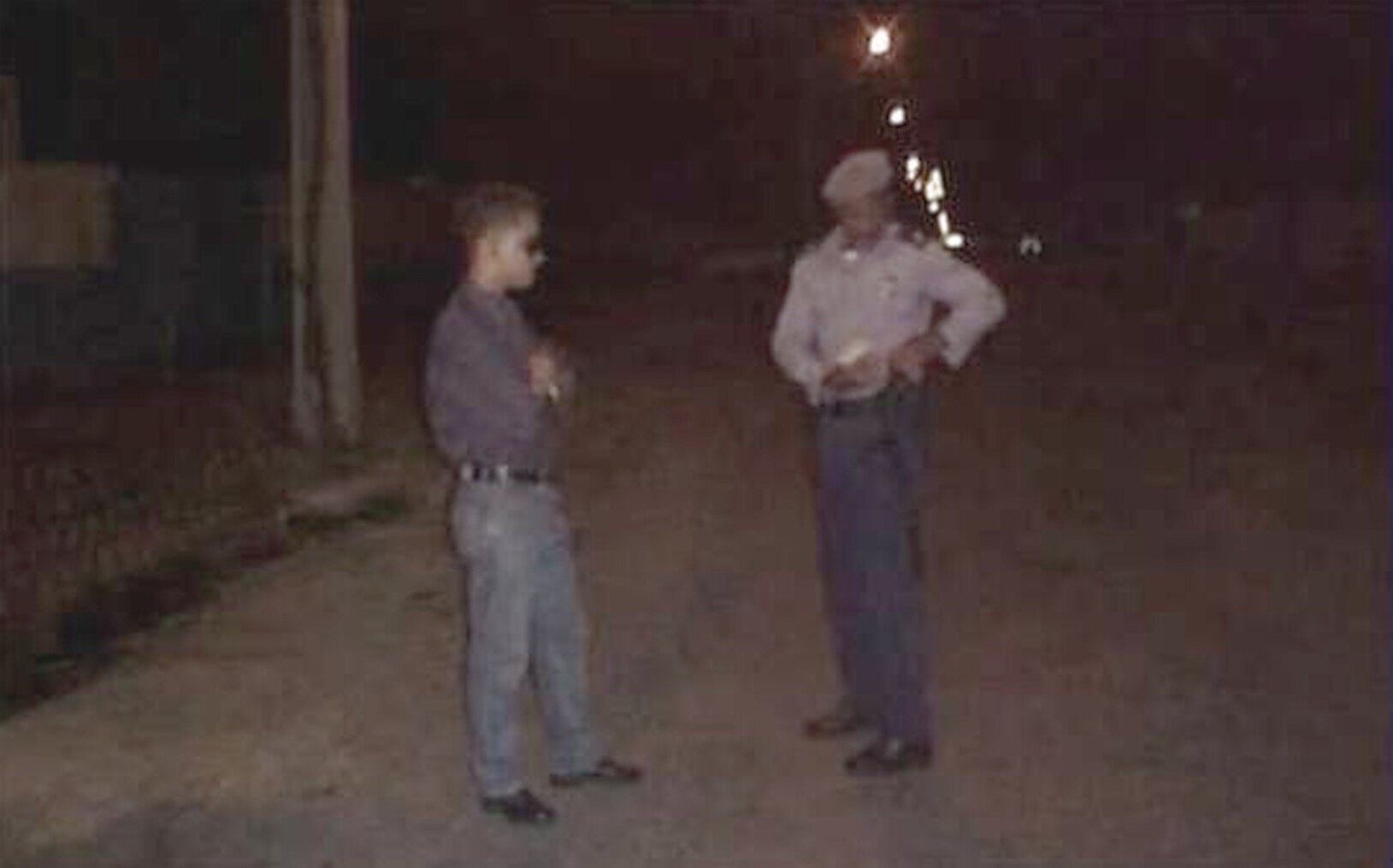
Published by the organization Camino a la Democracia de Cuba (CDC) and its president.
My name is Boris Mauricio Betancourt Hernández, a Cuban dissident, businessman and leader of the anti-Castro organization Camino a la Democracia de Cuba (Path to Democracy in Cuba, CDC). In the following pages I write about part of my life in Cuba, the repression I suffered at the hands of the Communist government, and part of my activism since I joined the opposition. This story will be published in international newspapers so that people may know part of what I lived through and the reasons that shaped my political struggle.
01My family
I was born on March 4, 1986, in one of the most beautiful neighborhoods in Cuba, the Palatino district of the Cerro municipality, in the City of Havana. I am the son of Mileydis Hernández Pérez, a very beautiful woman who studied nursing. Her parents, my grandparents, were Osvaldo Hernández, who had been a police sergeant under Fulgencio Batista, and Juana Rosa, “Mima,” both of whom suffered great persecution. Mima was the noblest woman I have ever known in my whole life. My grandfather never let her work, so she was a homemaker, and she was a Seventh-day Adventist. It was through her that I came to know the Church. Mima always reminded me of my first words, spoken when I was nine months old: “Christ loves me.” Those were my first words, and I said them inside my playpen, as Mima and my uncle Juan Carlos, who was there at that moment, used to tell me. My father is Boris Betancourt, son of my grandfather Luis Adrián Betancourt and my grandmother Sonia Stincer, who was always my fiercest defender. My father studied journalism, and in Cuba he worked writing scripts for the Radio Progreso program. My paternal grandfather and grandmother also studied journalism at the University of Havana, and that is where they met. My grandfather Luis Adrián Betancourt Sanabria was born on May 10, 1938, in Placetas, Villa Clara. He was one of Cuba’s well-known writers and journalists, mainly for his books and detective novels. He was director of the Union of Cuban Detective Fiction Writers and served as a correspondent in various countries. I am the only child of both my parents.
02The first memories that shaped my life
My parents were born in the municipality of Marianao and were neighbors; they lived just one house apart. When my mother was still very young, she, her parents and my aunts and uncles moved to the Las Cañas neighborhood in the Cerro municipality. They moved because of the intense persecution my grandfather suffered at the hands of Fidel Castro’s authorities for having been part of Batista’s government.
My maternal grandfather was never accepted at any job except cutting sugarcane in the failed cane fields of Fidel Castro’s Revolution. Years later he learned barbering and began cutting hair at home. He was the best barber in the neighborhood. He was always against Fidel Castro. Every afternoon he listened to Radio Martí in his room with an antenna he had invented himself, which picked up the shortwave signal from Miami. I liked to sit beside him and listen, and we would debate together. He always told me good stories about what life in Cuba was like before the Castros’ Revolution. We were very poor. It was in his house that I ended up eating cats, pizzas made with condoms, and onion-smothered “steak” made from a floor-mopping cloth. Those memories are part of the Cuba I grew up in and of a reality I have never been able to forget.
At the age of eleven I won the provincial literature contest “La Flauta de Chocolate” (The Chocolate Flute), where I told the story of my first little dog, “Coquina.” My first prize deeply moved my dad and my paternal grandparents, but the happiness was short-lived. As I was starting seventh grade in middle school, at the age of twelve, my father fell ill, and because of that, as my grandfather told me, he emigrated to the country I love so much today, the United States. Being separated from him plunged me into a deep depression. My father left me many memories that were impossible to forget. One of them was all the late nights when he kept me awake with the noise of his old typewriter as he put together the scripts he had to deliver the next day to the Radio Progreso station. I remember how carried away he got between his writing and listening to the Beatles on his Walkman; he didn’t even notice that I was sleeping in the room and had to go to school the next day. I also liked listening to music, like my dad, but Enrique Iglesias songs: I have always been a modern romantic. I sang in the shower every day, according to my grandparents, who were my only fans, as I was theirs. I dream of being able to hug them again.
On top of that, I began having trouble at school, so I failed eighth grade and had to repeat it. Halfway through eighth grade I was expelled from the José Martí school because the math teacher snitched on me to the principal: he showed her the leaflets I had been showing other students, with whom I was arranging to hand them out after classes. The teacher, an old man with Communist affiliations, also told the principal what I had said to him: that the leaflets were meant to get that shameless Fidel Castro removed from power. Saying that cost me dearly, both me and my beautiful mother, who had to pay a few “chavitos” (convertible pesos), and with God’s help I was accepted at the third school where we went to enroll me. At the first ones they told my mother they couldn’t keep me there because I was a “little counterrevolutionary gusano” (worm, the regime’s slur for its opponents), and all just for thinking differently.
Being separated from my father caused my first rejection of Fidel Castro’s communism. I began to ask myself why my dad had to emigrate from Cuba to find medicine and better food for his illness if, as my grandfather Luis Adrián used to say, Cuba had the best doctors and the best medicines in the world, all thanks to Fidel. After that I realized the Communists were liars, and I never again allowed anyone to speak well of the Revolution or of Fidel in front of me.
My father’s one-way journey, together with the Communists’ luxurious villas full of food while my other family and the people were starving, gave the lie to all the Castros’ promises. It was for those reasons that I decided to join the opposition and share the thinking of my first leader, my brother and neighbor Adrián Leiva. All the psychological damage Fidel Castro’s dictatorship has caused me since I was a child is incurable, indelible and non-negotiable.
03The contradiction
My cousins on my mother’s side had to bathe in an old fiber-cement tank with water that stank of fish, because it had been a fish shop’s tank; they had no swimming pools they could go to. Meanwhile, the leaders ate lobster and beef fillets in their luxurious restaurants while those foods were forbidden to the people: a neighbor of my mom’s got fifteen years because they caught him with a few pounds of beef in a backpack as he was taking it home to his family. It seemed a cruel act to me. I also watched all those police officers at the cadet schools practicing martial arts and thought about how they would later abuse the people in the streets over absurd things, just for thinking differently from them. They could stop someone in the street and, seeing that the person was far from home or walking late at night, beat them up and haul them off to jail.
Weekends were the most fun days and also the most stressful for me. Every week my schoolmates threw parties at their homes that the whole school attended; it was the only entertainment. I always had to wear the same clothes, because there was no variety and no money to buy more, let alone shoes. I had to wear my school shoes in the evenings too; I would run a brush over them to clean them so they looked new, but they were still the same shoes. There was no other choice.
With clothes I often managed to get by, but I had to walk twenty blocks to the home of my cousins Yosvany and Maikel, who lived with my maternal grandparents, and if I could talk them into it they lent me their clothes, which were too big for me but better than mine. Most of the time that is what I did, although they didn’t always lend them to me. If they didn’t, I had to tell my grandmother Mima, who always said yes: even though my cousins complained to her, I ended up winning her over and she always lent them to me. And when my cousins hid them, I walked ten more blocks, to the other side of the Calzada del Cerro, near the Maravilla, to talk Mayito into it, and he lent me his. El Mayo, as I called him, was the same age as my cousins, and we became very good friends. He is my little brother: he always said yes to me, and I will always count him as my good friend, who never let me down.
That is how I lived my adolescence and part of my youth in Cuba, and that is how Cuban young people still live, and even worse. In Cuba you live under constant stress about everything.
Meanwhile, my paternal grandparents, who raised me, moved from Marianao with my dad Boris Betancourt and my aunt Tatiana (Tati) to the Palatino neighborhood in Cerro, which happened to be a short distance from the streets of the neighborhood where my mother lived, so I could walk over to visit them. That house in Palatino was a gift from Fidel to my grandfather.
Like all intellectuals in Cuba, my paternal grandfather was recruited at a young age by the MININT (Ministry of the Interior) and belonged to State Security (DSE) and to the Communist Party of Cuba (PCC), and he received numerous awards and Communist membership cards. He was also given three firearms, one of them a black Colt .45 that the dictator Fidel Castro gave him as a gift. In addition, he enjoyed many privileges that most of the Cuban people could not.
04What my grandfather lost by defending me
My life in Cuba was an ordeal because of Fidel Castro’s communism. I only studied far enough to pass ninth grade, because they threw me out of school for thinking differently from the Castro regime, and because at the time I thought studying was a waste of time when I saw what a professional earned and how they were exploited. Nor did I work for the State, because what they paid wasn’t even enough to cover the household’s basic utilities, and because if I studied I had to belong to the Young Communist League (UJC), and if I worked for the State I had to belong to the Communist Party of Cuba (PCC), and that went against my free thinking and my convictions. I also refused to do compulsory military service, I never agreed to stand the night watches of the CDR (Committees for the Defense of the Revolution), and I never took part in any Communist activity, all of which caused great and serious problems for my grandfather, given his political record.
Years later they stripped him of all his membership cards, decorations and firearms for defending me and not allowing them to send me to prison. On more than thirty occasions he got me out of the holding cells of almost every police station in Havana, using his contacts in the MININT and State Security. In Cuba, whoever has contacts in the government doesn’t go to jail, but with me they ran out of patience. They took even my grandfather’s antiques and valuables, and they threw him out of the Communist Party of Cuba (PCC) like a dog in front of all his comrades, telling him it was for defending me and for having living in his house a grandson who, according to them, was a counterrevolutionary gusano, all for thinking differently from them.
05My paternal grandfather’s wish and how it shaped my ideas
Ever since I was a boy my grandfather wanted me to become a police officer, and so one day he gave me a police uniform. He also cooked for me and took me on picnics to different historic sites of the Communist Revolution; there he would work on my mind and tell me the story of what Fidel had done in those places. He also took me to MININT cadet schools, and as a reward he took me to their beach retreat called Villa Corral, in Boca Ciega, and to their club called Cristino Naranjo in Miramar. Besides these places, the Communists had other recreation spots with every kind of luxury, such as Costa Verde and Villa Lupe in Varadero, the Casa Central de las FAR (Revolutionary Armed Forces) in Miramar, the Hotel Mariposa in the City of Havana, Cayo Piedra and Cayo Blanco, among others. But none of that changed my way of thinking. On the contrary, it opened my eyes even more, because I saw the luxuries the Communists enjoyed and the food they ate while my other family and the people lived through blackouts, with no food and nowhere to go. That is why, at fifteen, I argued with my grandfather and told him I didn’t want to visit any of those places anymore. These arguments caused my grandfather two heart attacks, and although that made me very sad, I never changed my position.
06How I joined the opposition
The trigger, and my eventual entry into the opposition, came when I was 15 years old. Trying to help my mother and myself, I started hustling for a living, doing business on the street or on the “black market,” as the damned Communists taught us to call it. The Communists called it that because, according to them, those were shady dealings: if you didn’t work in their businesses, anything that wasn’t theirs was illegal, and therefore shady. They began to treat me like a criminal and to persecute me. I always told them that they were the real criminals, because they steal all of the country’s wealth, force the people to steal in order to survive, and force them to think like them. I sold basic necessities to Cubans who lack everything, goods that are illegal in no other country, but in Cuba, for the Communists, everything is illegal. I began selling powdered milk, chocolate, clothes and other things that Cubans can’t find in the stores to friends and acquaintances. The neighborhood chivatos (informers) quickly sprang into action, reported me to the jefe de sector (the neighborhood police chief), and I was marked, as they say in Cuba. The fights began with my grandfather, who didn’t want me doing that, but I kept going because in my view none of it was wrong, and soon came the arrests and the persecution. The fights with my grandfather grew worse and I exploded. I started shouting: “Down with Fidel!” “The Castros are murderers!” “Down with communism!” This made me bolder, and I began taking to the streets in protest. They quickly started locking me up, and they even sent me a police officer in charge of minors named Mayra González, a police captain and an admirer of the detective novels my grandfather was writing day and night at the time.
For years, the president of the block committee, Teodora Rosa Navarro Serrano, whom people called Dora, wife of the director of the Revolutionary National Police (PNR) academy, Daniel Maseda Arias; the woman who replaced her, Margarita Vargas, wife of a lawyer named Braudilio Juan Castellanos García who had accompanied the dictator Fidel Castro in his defense at the Moncada trial, both of them close friends of my paternal grandfather; as well as the block’s surveillance officer, Norma Dono, who was also the Party secretary of the local cell; and the jefe de sector, Ovidio, and the man who replaced him, Osmany Chacón, both of whom came to my house to threaten me that they would take me to jail if I didn’t stand the CDR watches and for doing business without going through them. They also threatened me over my differing political views and invented all kinds of crimes against me, false cases, and filed complaints and accusations against me that were starved of evidence.
They kept arresting me and sent me to almost every police station in the City of Havana, among them the Acosta station on January 31, 2003, with an officer named Alexis; I was also taken to Picota, where First Lieutenant Joel de Diego dealt with me.
On May 19, 2005, I was summoned to the Fourth Station, yet another outrage. I was detained and treated as a dangerous element. They had drawn up a “dangerousness” file on me, which had been sent to the prosecutor’s office for prosecution. Through an acquaintance of my paternal grandfather I learned that the people who allegedly pushed the file were Mayra González, the juvenile officer; Captain Gelmy L. García Vidal, head of the Palatino police; Ovidio, the jefe de sector; and Nailan Pérez of the DTI (Technical Investigations Department) mass-detection unit. A Party member from my grandfather’s cell, one of the secretaries, Norma Dono, informed him that counterintelligence (CI) knew I was a signatory of the Varela Project and also knew I had been given a certificate of membership in the Varela Project signed by Oswaldo Payá. On May 24, when I had already spent several days in the holding cell, my grandfather received a call from the PNR General Directorate, and I was released that same day. On June 1, patrol car 426 spent most of the early morning hours parked in front of my house. On June 3, I was detained: patrol car 522 came to my house to get me and took me to the Zanja station, with no arrest warrant and without telling me why or where it was taking me; they released me in the early morning.
On July 10 I was summoned again, this time to the Blanquita station, where the station chief, named David, and Captain Alberti acted in the most aggressive way: they wanted me to sign a document admitting to acts I had not committed, but I refused. Alberti took back the paper, threatened me, told another officer to reopen my dangerousness file, and warned me that it wasn’t going to be like last time: “I’ll know how to do it right, and they won’t throw it out on me no matter who your grandfather goes to see.” According to Alberti, any day now they were going to kill me for my escapades.
Patrol cars kept a fixed watch on my house, and plainclothes State Security agents, the G2, constantly monitored my movements and tapped my home phone. It was relentless persecution against me. All for thinking differently.
07Adrián Leiva, Oswaldo Payá and the Varela Project
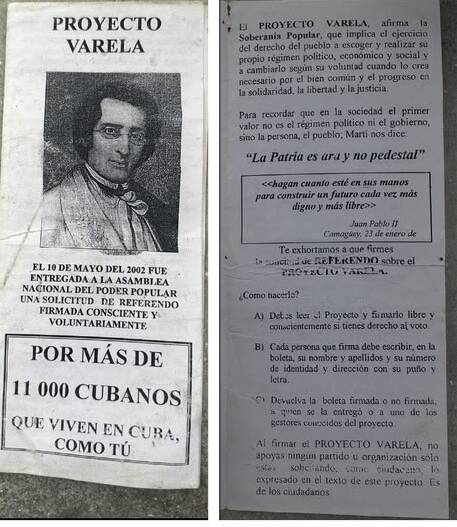
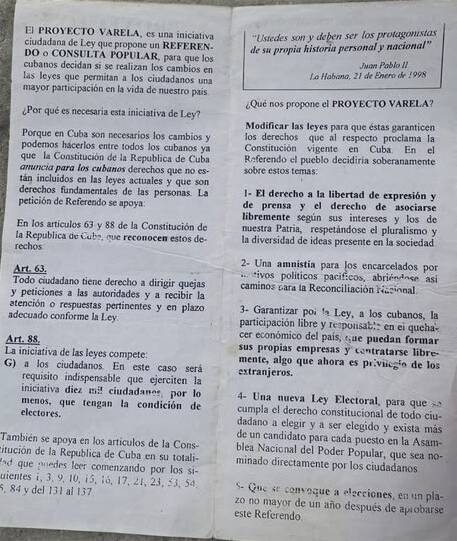
When I was 15, my stance and attitude caught the attention of my leader and neighbor Adrián Leiva, an activist in the Varela Project developed by the Christian Liberation Movement, and we became friends and started debating politics. Since I was a minor and could not sign the Varela Project, I helped by collecting signatures for the campaign and handing out banners, and at 16 I was able to sign and began as an activist in the Christian Liberation Movement (MCL) led by Oswaldo Payá. I took part in meetings, collected signatures for the project and recruited friends and acquaintances into activism. I handed out leaflets at schools, at bus stops, at hospitals, at the Mini Max store on Calzada del Cerro and in the streets; I painted graffiti; I began throwing leaflets from the tops of buildings; I smeared paint on the large canvas photographs of Fidel, Raúl and other leaders of the Revolution that hung on every block by obligation and doctrine. I ripped inscriptions off statues and tore down the wood-burned plaques placed on monuments, and the arrests began: more than thirty of them. I still keep some of the original leaflets I copied and handed out when I was 15 and 16.
08Torture, beatings, rights violations and the hunger strike
During those arrests, violating my rights and trying to break me, they split my head open, broke my jaw and a finger, and denied me medical care. That is why I have had blood pressure problems since I was 17: it went out of control in a holding cell at the “Picota” police station in Old Havana during my hunger strikes. Every time they arrested me they tortured me, beat me and threatened me. They wouldn’t let me see lawyers, only the station’s political officer, who threatened me and tried to get me to work for them. They put a bulb of roughly 1,000 watts in my cell that kept me from sleeping. They hosed me down with pressure hoses. They spat in my food. They blasted the television and radios at full volume with speeches by the tyrant Fidel Castro.
09Three months in Villa Marista
On another occasion, starting on January 2, 2008, they held me for about three months at Villa Marista, the headquarters of the State Security Department and its detention and interrogation center in Havana, Cuba, because they caught me a few blocks from the Plaza de la Revolución after I had thrown some flyers on the anniversary of the triumph of the Revolution. They allowed me no visits, no medical care and no lawyers. During the only visit they gave me, they tried to trick me. They paraded my mother past me dressed as a prisoner and, through a glass pane, told me it was my last chance to talk and tell them who my leaders were or who had given me those flyers. They said that if I didn’t tell them, they would lock her up. But I kept telling them I knew nothing about it and that it wasn’t me. They put me back in my solitary cell. A while later they let me see my mom. She told me they had dressed her like that because they had told her there was an epidemic and she had to put those clothes on. A few days after that they released me.
10Colonel José Veiga Gadea (Morán) and the attempt to recruit me
The day I was released from Villa Marista, my grandfather tricked me into going with him to the home of Morán, a friend of his and a State Security colonel, who at the time lived in a luxurious house in the Casino Deportivo neighborhood. Morán had a crew of old retired State Security men who were allowed, with sophisticated equipment, to dig up gold and relics all over the country: they were a kind of thieves licensed by State Security.
While they were talking in his living room, my grandfather told me he’d be right back, that he was going to the kitchen to leave his coffee cup, and he stayed in the kitchen talking with Morán’s wife. Then Morán began asking me whether I belonged to Oswaldo Payá’s opposition movement, or who my leaders in the opposition were. I answered that I didn’t know that man and wasn’t involved in anything against the Revolution. He kept telling me he knew I was, that I was lying to him, that I should trust him, that it was thanks to him I hadn’t been kept in jail other times, but that he would no longer be able to get me out of the cells and I was going to prison.
He offered me work with State Security. Just then my grandfather came out of the kitchen and we went home. On the way I told my grandfather that if he ever took me there again, I was going to slap that old man. My grandfather was offended. After that day, every time Morán came to visit my grandfather, I left the house through the backyard, jumped over the neighbors’ wall and got away. I didn’t want to see that old Communist’s face. Every time they arrested me they tried to recruit me. But I never accepted. Nothing could change my convictions.
11The day I met Oswaldo Payá in person
That day, when I got back from Morán’s house, I gave my grandfather the slip and went to see my leader Adrián Leiva. I told him what Colonel Morán had tried to do, and I told him what Morán and my grandfather had said: that they weren’t going to save me anymore, that they could no longer do anything to keep me out of prison, and that if I stayed in the opposition they would lock me up for many years. Adrián congratulated me and was very pleased. I remember he told me I would go far in the opposition if I kept it up.
A few days later he sent for me through another activist. The activist came to my house and gave me the password we always used when we needed to meet urgently. I went to see him right away. When I arrived at his apartment, he introduced me to Oswaldo Payá. It was the first time I met him. That day they gave me a recognition, and I answered their questions about all the times I had been jailed and the threats that had been made against me, that they could no longer keep saving me from prison.
Together with Adrián, they told me they were going to take me off the streets. I offered to spy on my grandfather and pass on to the movement all the information I could get. And so I did, until I left for the United States. Years later, the regime tried to infiltrate several of its informants (spies) living in the United States, Mexico and Costa Rica into my opposition organization, and I, being too trusting, told them this story; months later, in 2020, they assigned a permanent State Security agent to my grandfather in Cuba. I will soon tell that whole story, in more detail, in my book.
12The arrests and the file they built against me
Many times a patrol car would pull up at my house and take me in for no reason at all. They didn’t even tell me where I was going or why. They only said they had orders to take me. They put me in the patrol car and took me away. Then they released me two or seven days later. One of those times, on May 17, 2005, the patrol car stopped in front of my grandparents’ house in Palatino, where I was born. They came to get me to take me to jail, with no reason or explanation. Over time I realized it was to fatten up a file on me and invent false crimes: two days later, on May 19, they summoned me to the Fourth Station, and they already had a dangerousness file drawn up against me. One of the legal devices they used against me was the so-called dangerousness law, under which they could try to sentence a person without that person necessarily having committed any specific crime, on the argument that he might commit one.
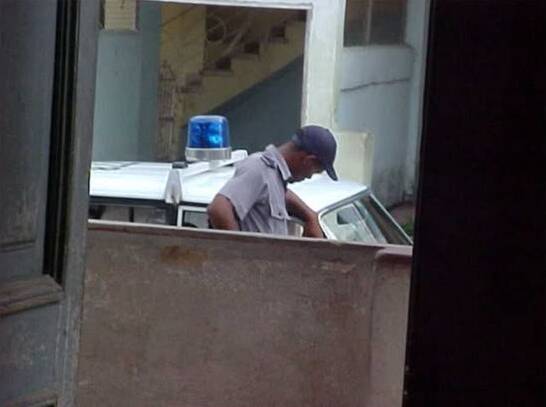
Another time they took me in for contempt of authority, merely for asking a police officer why he was detaining me. On another occasion, in August 2002, a police officer fined me for “disobedience” at Calzada del Cerro and Primelles just because I asked him why he was asking for my ID card. They also detained me for damage to State property because they found graffiti on a wall near my house. I am convinced they would have killed me or given me many years in prison, as has happened to so many opposition members in Cuba. I expect anything from the dictatorship of Cuba’s government. I also carry with me the pain of the murders of my leaders Oswaldo Payá and Adrián Leiva, who left a deep mark on my life and on my entry into the opposition.
13My faith: God, Orula and the orishas
I believe in God and consider Him, above all, our creator; He is the Lord of Hosts. I also believe in the word of Orúnmila and the orishas, since at 16 I was initiated into the Afro-Cuban Yoruba religion practiced in Cuba. At that age I received the hand of Orula, Osun, Elegguá and the warriors (Ogún and Oshosi), and later my guardian angel, Oddúa. When I had to leave Cuba, I continued in the religion in Miami and became a priest of Orúnmila (babalawo). Orúnmila gave me the sign of Baba Eyiogbe.
Most Cubans come to this religion seeking well-being for their health; others have taken it up as a fashion. In my case, I came to it for political reasons: to ward off and evade the fierce persecution of Cuba’s Communist police. Even though they persecuted me, watched my house and arrested me dozens of times, the religion guided me many times. I believe Orula always warned me and helped us, both me and my grandfather, to get me released, and protected everyone in the house. Throughout my life, my faith has always been at the service of Cuba’s freedom.
14I had to leave my country
When they told my grandfather they would no longer help him with me and that I was going to end up in prison, they called my dad, who was living in the United States, and asked him to file a family petition for me right away, because they couldn’t handle me anymore: they had realized nothing could make me change my way of thinking. That was when my dad hired a lawyer and sped up the paperwork for my petition. I had to agree to leave my country without wanting to; I was practically forced to, because otherwise they were going to put me in prison for many years.
When my dad’s petition for the United States came through, they wouldn’t let me leave the country because I had always refused to do military service. My grandfather had to trade his passport for my exit from the country, and they agreed. A month later, on September 18, 2009, I traveled with my father to Miami, in the United States. But leaving Cuba did not mean I stopped supporting the cause of the Cuban opposition.
15My grandparents today: persecuted in their own home
Today, my grandfather Luis Adrián Betancourt has published more than a dozen books, which are sold in more than 200 bookstores in more than ten countries. He also has copies of his books in the prestigious Library of Congress of the United States. I have always wondered: who is collecting the royalties for all of my grandfather’s books in all those bookstores? Who is publishing his books, while my grandparents survive on what my father and I can send them? My belief is that the Castros’ Communist government bargained them away, just as they made him trade his passport so I could leave Cuba, or that behind those books there are fake profiles: Communists posing as intellectuals around the world in order to spy and steal information for Cuba’s G2.
Today my grandfather is in Cuba with my grandmother, my protector, in their old house in Palatino. That government has taken everything from him. They keep them under constant persecution and threats: they tell them they have to talk to them about me, and that if they don’t, they will take their house. They search their home, watch them, spy on all their communications and track their every step, as if we were their property and as if Cuba belonged to them.
My grandparents are cared for by my aunt, Tatiana Betancourt, and my cousin, Amaury Ortiz. A State Security agent who calls himself Valentín has also offered my cousin work: he told him that, if he wanted, he could work for them at whatever job they gave him. They have started doing to him the same thing they did to me: they want to recruit him. Whatever happens to my grandparents, my aunt and my cousin will be the responsibility of Díaz-Canel and his dictatorship.
Like most families in Cuba, my grandparents survive thanks to us, their relatives in exile, and thanks to the goodwill of the United States of America and its allied countries, which take us in. The Cuban government only thinks about saving itself, and if you don’t obey the repressive apparatus, they discard you and switch you off, like the blackouts.
16My gratitude to God and to the United States
My youth in Cuba was very hard, because of the Castros’ Communist government. I thank God for all the help He gave my father so that, from the United States, he could help us. And I thank God for the United States: if it weren’t for you, my dad would have died, and I don’t know what would have become of my family and me. All of us Cubans are deeply grateful to God and to the United States. That is why we love you more every day; without you, Cuba would not exist.
17The dictatorship persecutes us in exile, too
The persecution did not end when I left Cuba. In February 2026, the regime detained in Cuba ten Panamanians who had gone on behalf of CDC to support the Cuban people, and seven of them are still in prison. On September 10, 2026, Panama’s Ministry of Foreign Affairs released, on its official letterhead, a statement signed as “Relatives of the seven Panamanians detained in Cuba,” asking us to “refrain” from continuing to speak publicly on their behalf. Almost every newspaper in Panama repeated it, as did Prensa Latina, the Cuban regime’s official news agency, which called us a “counterrevolutionary organization.” We respect those families’ pain, but for us it was a threat delivered in advance: what followed was a complaint against our spokeswoman that, according to our lawyer, is starved of evidence, and news items that lie about my mother.
My answer is this: if that persecution against us continues, let all those Communists be the ones to refrain. Our Cuban opposition and the Cuban exile community must be respected.
18This is not just my story
This is not just the story of part of my youth in Cuba. It is a call for everyone, inside and outside Cuba, to lose their fear and denounce the dictatorship. We know that in most Cuban families there is a “Communist snitch”; don’t let having a grandparent or a family member in the police force make you keep quiet or tolerate the regime’s abuses. Tell your story, speak out, take to the streets in protest. Never stay silent: fear does not exist, it is never too late, and above all, trust in God.
Tell your Communist relative, as I told my grandfather: they don’t love you; the Castros are traitors; they betrayed you, their own friends, everyone who believed in them and the entire Cuban people. Don’t go on being deceived: change has to come NOW.
Down with the dictatorship of the Castros and Díaz-Canel!
“Man grows old too soon and wise too late, just when there is no time left.”
Boris Mauricio Betancourt Hernández, Cuban dissident, businessman and leader of the anti-Castro organization Camino a la Democracia de Cuba (CDC)